Phone Case Thickness: How Thick Is Right for You?
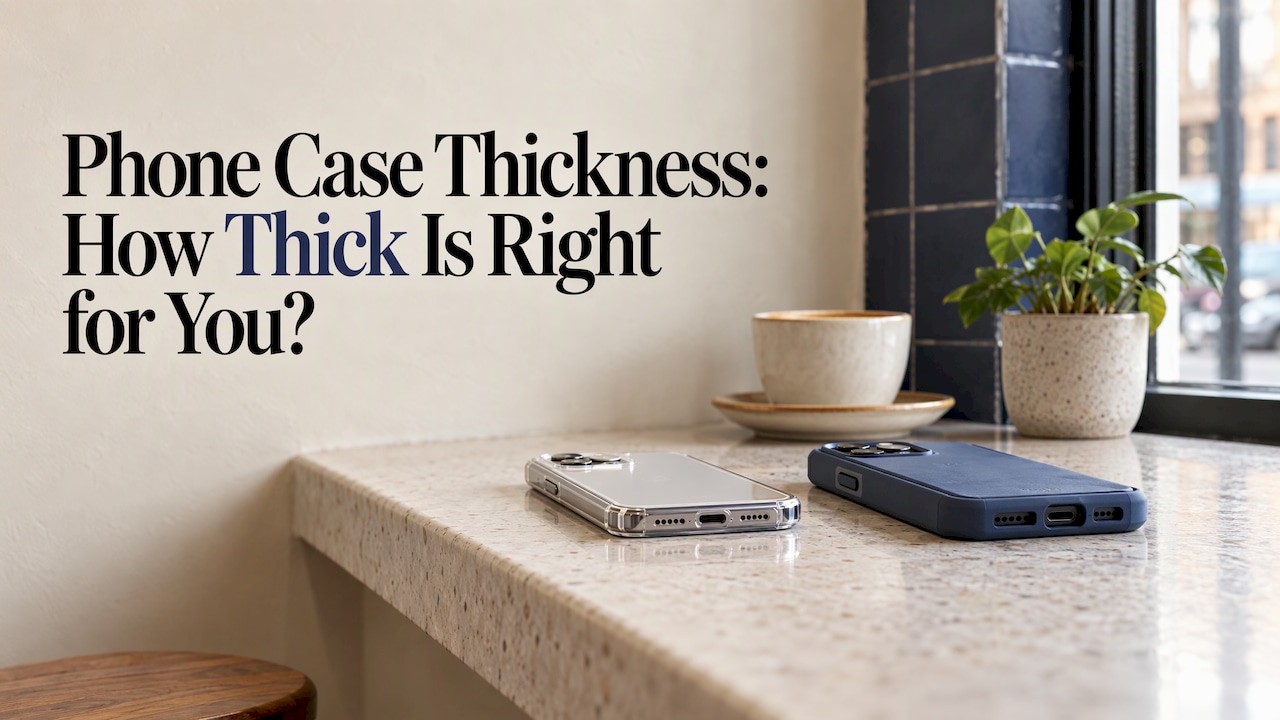
Most phone cases add somewhere between a hair and a few millimetres to your phone, and that small number decides how the phone feels in your hand, whether it slides into a jeans pocket and how well it survives a drop. The right thickness is the one that gives real cushioning at the corners and around the camera without turning your phone into a brick. This guide shows you how to read thickness, what to compare and how to choose.
TL;DR
- Case thickness is the extra depth a case adds to your phone, and the thickest point is usually the raised lip around the camera.
- A very thin case has less mass and less room for cushioning, so it gives less drop protection than a case with more structure.
- Judge a case by its construction (layers, corner and camera lip), not by a single millimetre figure in a listing.
- Bigger phones feel heavier already, so you have less room for bulk but more reason to want cushioning.
- Always buy for your exact model name, because thickness and cut-outs are built around one phone’s body and camera.
Table of Contents
- What phone case thickness actually means
- How to measure and compare thickness
- Does a thicker case protect better?
- Thickness and weight
- Slim versus thick in everyday life
- Choosing thickness for your phone size
- Will a case fit? Thickness and model compatibility
- Our perspective on thickness
- Find your MONTE case
- A quick checklist before you buy
- FAQ
- Sources
What phone case thickness actually means
Case thickness is how much depth the case adds to the phone when it is on. If your phone is 8 mm thick and the case adds 2 mm to the back and the camera area, you are carrying a 10 mm package. It sounds simple, but a case is not one flat slab, so there are really three numbers hiding inside it:
- Back thickness: the wall behind the phone, which decides how the phone sits on a table.
- Edge or rim thickness: the walls around the sides and the raised lip around the screen, which decide how the case feels in your grip and how it protects the glass when the phone lands face down.
- Camera lip height: the raised border around the lenses, which is usually the thickest part of the whole case.
The camera area matters most. Android Police notes that the thickest point of a case will usually be around the camera, because that is the first area to touch a surface when you set the phone down or when it lands on its back. The same article says a case with essentially no lip around the camera is too thin.
How to measure and compare thickness
Measuring is easy if you have a ruler with millimetre markings or a pair of digital callipers. Do it in this order:
- Measure the phone alone at its thickest point, which is normally the camera bump.
- Put the case on and measure the same spot again.
- Subtract the first figure from the second. That is what the case adds.
- Repeat along the side rail, so you know how it feels in your hand and pocket.
When you are shopping online you cannot do this, so you rely on the listing. Be a little careful with the numbers there. Android Police points out that it is hard to judge thickness from photos, and that you should not trust any “only 0.XX millimetres” claim without seeing the case in person. A useful habit is to look at the side-on photos, find the camera lip and the corners, and check whether the product description mentions how the case is built.
Slim, medium and bulky: a rough way to think about it
There is no official standard for these words, so every brand uses them a little differently. As a practical rule of thumb, think of it this way:
| Style | What you notice | Best for |
|---|---|---|
| Slim | Barely changes the size of the phone, easy to pocket | People who prioritise a low profile and light weight |
| Medium | A little more grip and presence, room for layered construction | Most everyday users who want style and drop protection |
| Bulky | Clearly larger and heavier, often with thick corners | People in rough work or outdoor settings |
The point of the table is the trade-off, not the label. Two cases that both measure 2 mm can feel very different if one is a single flexible shell and the other is built in two layers with a firmer outer frame.
Does a thicker case protect better?
Often, yes, but thickness alone is not the whole story. According to Android Police, the sleeker a case is, the less mass it has to absorb a drop and the less room it has for air cushions, and a thin case can also become too brittle to protect the phone. So a gram-shaving case trades away some of the very material that does the work in a fall.
What really matters is how the thickness is used:
- Corners: most falls end on a corner, so this is where extra material and cushioning pay off.
- Raised edges: a lip above the screen and around the camera keeps glass off the ground when the phone lands flat. If you are worried about your lenses, our guide to protecting your phone camera lens covers how a lip works without getting in the way of photos.
- Layering: two materials working together can spread an impact better than a single wall of the same total thickness. Our guide to phone case materials explains what each material contributes.
A word on drop ratings
You will see “military-grade” on plenty of listings. The reference is a US military test standard, and it is worth knowing what it asked for. Android Police explains that MIL-STD-810G 516.6, released in 2008, required surviving 26 drops from 48 inches onto a concrete-backed plywood floor on each face, corner and edge. The newer 810H 516.8 from 2019 raised the height to 60 inches and swapped to a concrete-backed steel floor, yet the older 810G method is still the one almost all cases cite today.
The same article cautions that these ratings on case listings are self-reported, and that many cases now claim 12, 20 or even 50-foot drops. It suggests a properly heavy-duty case should be tested in at least the 8 to 16 foot range. So treat a rating as one piece of information, and look at construction and the brand’s own description of how the case was designed.

Thickness and weight
Thickness and weight usually travel together, but not always. A very thin case can add almost nothing. Android Central reviewed an aramid fibre case for the Galaxy S23 Ultra that is about 0.76 mm thick and weighs roughly 13 grams, so it adds almost no bulk. That is the extreme end of the scale, and it shows how much range there is between an ultra-minimal shell and a case designed to cushion a fall.
In day-to-day use, extra weight shows up in three places: how your wrist feels during a long scroll or video call, how your pocket or small bag sits, and how the phone feels when it is on a magnetic charger or mount. If you use a MagSafe-style accessory, remember that anything you stack on the back adds to the total, so a slim wallet and a sensible case work better together than a heavy case and a heavy wallet.
Slim versus thick in everyday life
Pocket and bag. A thinner case slides in and out more easily, particularly in fitted jeans. A more substantial case sits more firmly but takes a little more room.
Grip. Extra thickness on the rails gives your fingers something to hold. This is helpful on big phones and glossy backs, which tend to be slippery.
Look. Slim cases show off the phone’s own shape. A slightly fuller case lets the design carry more of the look, which is where colour, pattern and finish come in.
Buttons and ports. Thicker rails can make side buttons feel a little different. Good cases keep the button covers or cut-outs responsive, so give the page a read for the way the buttons are handled.
Face-down protection. A raised edge over the screen matters more than the back thickness here. It is the small lip, not the overall bulk, that keeps the glass from touching a table.

Choosing thickness for your phone size
Bigger phones change the balance. As Ara Wagoner explains in the same Android Police guide, large phones such as the Galaxy S23 Ultra already feel supersized and heavy, so you have less leeway for a thick case, yet more need for cushioning because more mass means greater forces when the phone falls. That is the dichotomy: you want protection but you do not want a stuffy feel.
A simple way to settle it:
- Compact or standard phone: you can afford a case with a bit more structure without losing one-handed comfort.
- Large or Max-size phone: look for a case that puts its thickness where it matters (corners, camera lip) rather than adding bulk everywhere.
- You drop things often or carry the phone in a bag with keys: lean towards more cushioning at the corners and a clear lip around the screen and camera.
- You mostly use the phone at a desk or in the car: a lighter build is usually enough.
If you want to dig further into matching a case to your habits, our guide on how to choose a phone case that fits your phone and style walks through the decision step by step.
Will a case fit? Thickness and model compatibility
Thickness does not decide fit by itself. Fit comes from the case being moulded for one phone’s body: its length, width, corner radius, button positions and camera layout. Two phones from the same family can look almost identical from the front and still have different camera cut-outs, which is why a case for one model may not sit correctly on its neighbour.
That is also why people often ask whether a case for one iPhone fits the next one up or down, or whether the standard and Pro versions share a case. The safe answer is to buy for your exact model name, which you can find under Settings, General, About on an iPhone. Our guide to iPhone case compatibility lists which cases belong to which iPhones, so you do not have to guess from the screen size.
When the listing mentions a MagSafe-compatible build, thickness can also affect how well your phone holds onto magnetic accessories. Anything very thick between the phone and a magnet can weaken the hold, so check the product description of both items.
Our perspective on thickness
We design MONTE cases around a simple idea: you should not have to choose between a case that looks good and a case that protects. That is why our cases are built with dual-layer protection that is designed to withstand drops, rather than relying on bulk alone.
When people ask us about thickness, we think the useful question is where the material sits. Corners, the lip around the screen and the area around the camera do most of the work in a fall, so that is where we want the structure to be. Spreading thickness evenly just to hit a number does not give you a better case, it gives you a heavier one.
We also make our cases in limited runs, so the look is part of the product and not an afterthought. A case you enjoy looking at is a case you will actually keep on your phone every day, and a case that stays on is the one that protects.
Our advice: pick the case for your exact model, choose a design you love, and look for a layered build that is designed for drops. Then match the rest of your set, wallet, strap or AirPods case, so everything feels like it belongs together.
Josua
Find your MONTE case
If you want a layered case in a design that is made in limited runs, start with our phone cases for iPhone, Samsung and Pixel, priced at $79. Pick your exact model, then choose the design that suits you.

Want a coordinated set? Our MagSafe wallets are $49, AirPods cases are $39 and AirPods Max cases are $49. For other devices, we also make iPad cases at $109, MacBook cases at $99 and Kindle cases at $69. You can also mix and match styles and accessories into a custom bundle.
A quick checklist before you buy
- Confirm your exact model. Check Settings, General, About, then match it to the case listing.
- Look at the side-on photos. Find the camera lip and corners, then check they look raised and defined.
- Read the build description. Look for layers, corner design and the way the brand describes drop protection.
- Think about size. The bigger the phone, the more you will notice every extra millimetre and gram.
- Think about accessories. If you use a wallet, grip or ring holder, make sure the combined stack still feels comfortable. A ring holder at $19 adds very little depth, while a magnetic grip at $44 sits a little further off the back.
- Pick a design you love. You will see it every day, so it should feel like yours. Our guide to personalising a phone case shows how to do that without giving up protection.
If you travel a lot, a bit of extra cushioning is worth thinking about, and our notes on protecting your phone while travelling cover the habits that help. For the other half of the equation, the screen, see how to prevent phone screen cracks.
FAQ
How thick is a typical phone case?
There is no single standard. Cases range from ultra-thin shells under 1 mm, such as the roughly 0.76 mm case Android Central reviewed, up to bulky protective designs that add several millimetres. Most everyday cases sit between these two ends. Measure the phone with and without the case at the camera to see what any case actually adds.
Does a thicker phone case protect better?
Usually it gives more room for cushioning and more mass to absorb a fall, while very thin cases can be less protective. How the thickness is used matters too: raised corners, a lip around the screen and camera, and a layered build all help. Look at construction as well as the millimetre figure.
Will a case for one iPhone fit another model?
Not reliably. Cases are moulded for one phone’s size, button positions and camera layout, and neighbouring models can differ in ways that are hard to see. Buy for your exact model name, and check our iPhone compatibility guide if you are unsure.
Where is a case usually thickest?
Around the camera. The raised lip there is usually the thickest point because it is what touches a surface first when the phone is set down or lands on its back, according to Android Police. A case with almost no lip there is probably too thin to guard the lenses.
Can I trust a military-grade drop rating?
Treat it as one clue. The ratings on listings are self-reported, and the commonly cited 810G method dates from 2008, as Android Police explains. Read how the case is built and how the brand describes its protection.
Sources
- 6 things to look for in your next phone case, Android Police
- Why most military-grade cases need to go back to basics, Android Police
- Thinborne ultrathin case for Samsung Galaxy S23 Ultra review, Android Central