Phone Case Materials: What Each One Does and Which to Buy
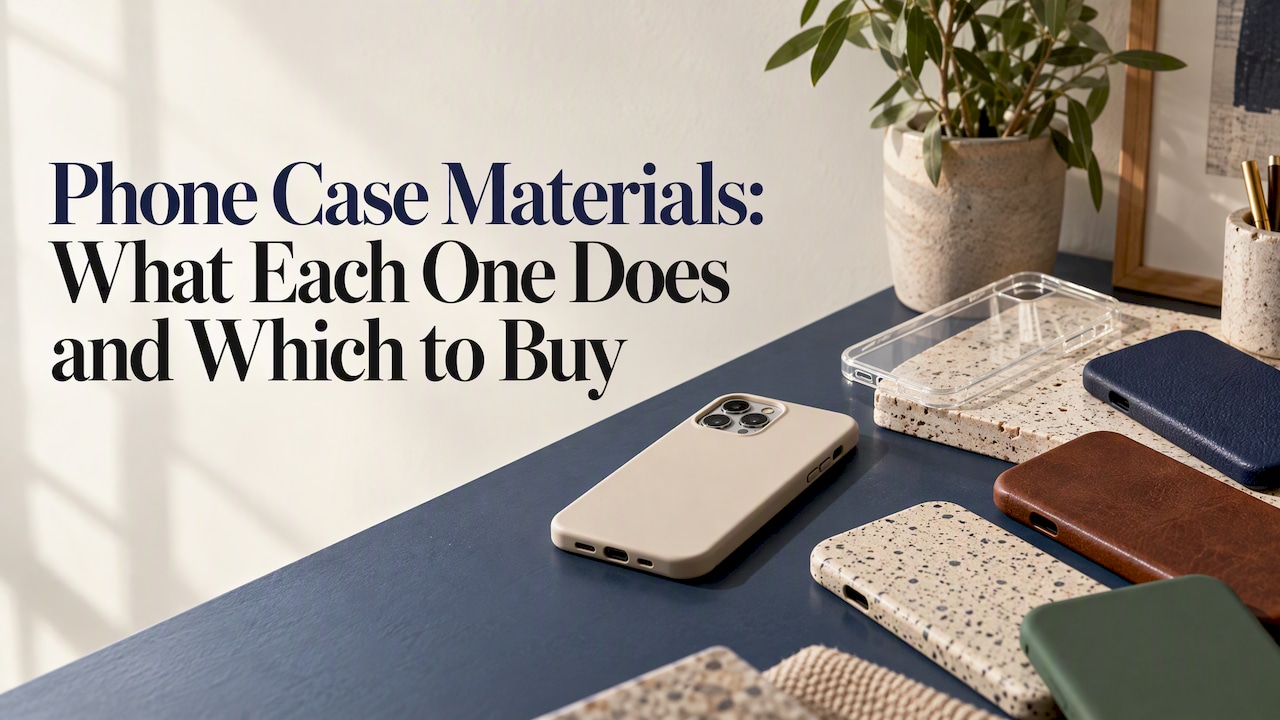
Most phone cases are made from one of six materials, often two in combination: silicone, TPU, polycarbonate, leather (real or faux), aramid fibre, and a few natural or specialty options such as wood or bamboo. For everyday protection, a hybrid of soft TPU inside and a rigid polycarbonate shell outside is the safest all-round choice. Silicone suits grip and budget, leather suits looks, and aramid suits anyone who wants almost no bulk. The rest of this guide explains why, so you can read a product page and know what you’re getting.
TL;DR
- Hybrid (TPU + polycarbonate) is the best all-round pick for drops, because the soft layer absorbs the hit and the hard layer spreads it.
- Silicone is grippy and soft but picks up lint and marks, and gives good rather than great protection.
- Leather and wood look good and age with character, but they protect less against hard drops, and thick leather can trap heat.
- Aramid fibre is the thinnest strong option and doesn’t get in the way of 5G or wireless charging.
- Check the product page for the material name, the number of layers and the lip height around the screen and camera.
Table of Contents
- Why the material matters more than the print
- Silicone: soft, grippy and forgiving
- TPU: the flexible all-rounder
- Polycarbonate: the hard shell
- Hybrid cases: TPU and polycarbonate together
- Leather, faux leather and wood: style first
- Aramid fibre: thin, stiff and signal-friendly
- What we think about phone case materials
- How to choose: match the material to your life
- Looking after your case so it lasts
- What to do with an old case
- Match your case to the rest of your devices
- Shop MONTE phone cases
- FAQ
- Sources
Why the material matters more than the print
A case’s material decides how it feels in your hand, how it ages and how much of a fall it can absorb. Phone Balls’ materials comparison makes the same point: most listings name one of six materials, and a few details on the page tell you which one you’re buying.
That matters because two cases that look identical in photos can behave very differently. One stays crisp for two years. The other yellows, stretches or cracks at the first corner drop. If you pick by colour alone, you find out the difference the hard way.
Here is a quick overview before we go through each material in detail.
| Material | Feel | Drop protection | Bulk | Main weakness |
|---|---|---|---|---|
| Silicone | Soft, grippy | Good | Light to medium | Attracts lint and stains |
| TPU | Flexible, smooth to slightly tacky | Good to very good | Light to medium | Can yellow if clear |
| Polycarbonate | Hard, smooth | Good for scratches, weaker alone for impact | Slim | Can crack on hard hits |
| Hybrid (TPU + polycarbonate) | Firm with soft edges | Excellent | Medium | Slightly thicker |
| Leather / faux leather | Warm, textured | Moderate | Slim to medium | Wears, can trap heat |
| Aramid fibre | Stiff, matte | Scratch and light impact | Very slim | Higher price, less cushioning |
The protection ratings here are general comparisons, not lab results. ComputerCity’s guide to phone cases rates silicone as moderate for durability with good drop protection, and TPU or polycarbonate as high for durability with excellent drop protection. Android Authority notes that phone cases are generally made from polymers such as TPU and polycarbonate, which is why you’ll see those names so often.
Silicone: soft, grippy and forgiving
Silicone is the material most people picture when they think of a “soft” case. It feels rubbery, grips the hand and stops the phone sliding off a couch arm or a car dashboard.
What it does well
- Cushions small bumps and everyday knocks.
- Gives plenty of grip, so you’re less likely to drop the phone in the first place.
- Usually cheaper than premium materials.
Where it falls short
- It attracts lint, dust and pocket fluff.
- Light colours can stain from denim dye or ink. Android Authority’s guide warns that a cream-coloured case looks great at first but stains will be its worst enemy.
- It can feel bulky in a tight pocket, and it tends to drag when you slide the phone in and out of jeans.
Silicone is a good fit if you want grip and a soft feel, and you don’t mind a case that needs wiping down. If you’re comparing it with TPU, the short version is this: silicone is softer and grippier, TPU is usually a little firmer and holds its shape better.
TPU: the flexible all-rounder
Thermoplastic polyurethane (TPU) is a flexible, impact-absorbing plastic. It sits between silicone and hard plastic: it bends under force, then returns to shape. It resists oil and everyday abrasion better than many soft materials, and it’s easy to mould into precise button covers and camera cut-outs.
By itself, TPU is common in slim, clear or coloured “gel” cases. Its real strength shows when it’s paired with something rigid, which is the hybrid design covered below.
The usual complaint with clear TPU is yellowing over time from sunlight and skin oils. If you want a clear case that stays clear, ask how the manufacturer treats it, or choose an opaque colour that hides ageing.
Polycarbonate: the hard shell
Polycarbonate is a rigid, strong plastic. On its own, it makes slim, hard cases that resist scratches and keep the phone’s shape visible. It spreads force across a wide area, which helps stop impact damage reaching one spot.
The trade-off is that a hard shell with no cushioning behind it can transmit shock to the phone, and thin polycarbonate can crack or pop off at a corner on a hard drop. That’s why you rarely want polycarbonate alone if you drop your phone often.
This is the answer to “silicone or polycarbonate?”: silicone absorbs, polycarbonate resists. Silicone is better for repeated small knocks. Polycarbonate is better for keeping scratches off and keeping the case slim. Neither is the best at both jobs, and that’s the reason hybrids exist.

Hybrid cases: TPU and polycarbonate together
A hybrid case pairs a soft, impact-absorbing inner layer, usually TPU, with a rigid polycarbonate outer shell. Phone Balls describes these as widely considered the gold standard for daily protection, because the soft layer absorbs shock while the hard layer keeps the structure together and distributes drop force.
In practice that gives you:
- Soft corners and edges that take the hit.
- A firm back that doesn’t flex, so prints and finishes stay put.
- Better scratch resistance than soft materials alone.
The cost is a little extra thickness. For most people that’s worth it, since the phone you’re protecting is the most expensive thing in your pocket.
Leather, faux leather and wood: style first
Leather and wood cases look great and feel distinctive. They also develop character: real leather darkens and softens with use, which many people like.
Two things to know before you buy:
- They protect less against hard drops. They’re better at preventing scuffs and surface scratches than at absorbing a fall onto concrete.
- They hold heat. Croma’s buying guide notes that thick, insulating materials like leather, or poorly designed cases, can trap heat during intensive tasks such as gaming or video recording, which could affect the phone over time.
If you do choose real leather, it helps to understand the grade. Here’s a clear explanation of full grain versus top grain leather and what each does to patina and scuff resistance. Faux leather (often called vegan leather or PU leather) is cheaper and more uniform, but it can peel at the edges over time, especially in a warm pocket or car.
A good compromise is a hybrid case with a leather-look finish on the outer layer, so you get the texture without losing the protective structure.
Aramid fibre: thin, stiff and signal-friendly
Aramid fibre, often called by the brand name Kevlar, is the minimalist’s choice. Phone Balls notes that it offers stiff, scratch-resistant protection with almost no bulk, and that it doesn’t interfere with 5G or wireless charging, unlike some metals.
It’s an excellent pick if you hate bulky cases and mostly want to guard against scratches and light knocks. It won’t cushion a big fall the way a thick hybrid will, and it usually costs more.
High-performance fibres are a whole field of their own. If you’re curious about how materials like these are used for protection elsewhere, here’s a primer on what UHMWPE is and why engineers choose it for impact and cut resistance.
What we think about phone case materials
We design MONTE cases around one idea: a case should look like something you chose, not something you put up with. That means fashion-forward designs made in limited runs, but it never means giving up protection. Every MONTE phone case uses dual-layer protection built to withstand drops, which is the same principle as the hybrid construction above: one layer to absorb, one to hold the structure.
Here is how we think about the choice:
- Protection comes first, then style. A beautiful case that cracks on the first drop is a bad case. Start with a layered build, then choose the design.
- The material should match your day. If you commute with your phone in a bag full of keys, scratch resistance matters. If you’re on site or on the move, shock absorption matters more.
- Don’t buy on a photo. Look for the material name, the layers and the raised edge around the screen and camera.
- Coordinate your accessories. Phone, AirPods, wallet and tablet cases that match feel like a set, and a matching set is more likely to be used and looked after.
Our limited-run approach means a design may not come back once it sells out, so if you find one you like, it’s worth grabbing it while it’s in stock.
— User
How to choose: match the material to your life
Use these questions to narrow it down.
- Do you drop your phone often? Choose a hybrid with a soft inner layer and a firm shell.
- Do you want the slimmest possible case? Look at aramid fibre or a slim polycarbonate shell, and accept that cushioning is lower.
- Do you want grip? Silicone or a soft-touch TPU finish.
- Do you want a premium look? Leather or a leather-look finish, ideally on top of a protective structure.
- Do you use wireless charging or MagSafe? Check that the case is thin enough at the back and compatible with magnets. MagSafe wallets and grips work best with a case designed for it.
- Do you game or film for long periods? Avoid thick, insulating cases and pick something that lets heat out.
A quick checklist before you buy
- Is the material named on the product page (not just “premium”)?
- Does the case have raised edges around the screen and camera?
- Are the button covers firm and responsive?
- Is the case designed for your exact model, not a generic size?
- If it’s clear, what does the maker say about yellowing?
Looking after your case so it lasts
Material choice sets the ceiling, but care decides whether you reach it.
- Wipe it down regularly. A damp cloth removes oil, lint and dye transfer. Do this more often with light colours.
- Avoid leaving it in a hot car. Australian summers are hard on every plastic and adhesive. Heat can soften soft materials and warp or peel finishes.
- Take the phone out occasionally. Grit gets trapped between phone and case and can scratch the phone itself.
- Replace it when it’s worn. If the edges have stretched or the corners are cracked, the case no longer absorbs impact properly.
Apple’s own guidance says the iPhone is made of metal, glass and plastic and contains sensitive electronic components that can be damaged if it’s dropped, which is the reason to protect it with a proper case in the first place.
What to do with an old case
When a case wears out, don’t just bin it. Plastic cases are recyclable in Australia through MobileMuster, the industry’s product stewardship program. MobileMuster says its recycling partner can recover more than 95% of the materials in a mobile phone, and that it can even recycle plastic cases and accessories. Drop-off details are on their site.
Match your case to the rest of your devices
The same material logic applies to the other things you carry. A tablet or e-reader is often thrown into a bag, so a protective shell matters there too. Your earbuds and headphones take plenty of knocks, and a wallet or grip that sticks to your phone is only useful if it stays attached.
Here’s where to look at MONTE for each:
- AirPods cases and AirPods Max cases to match your phone.
- iPad cases, MacBook cases and Kindle cases for bigger devices.
- MagSafe wallets for cards without a second bag.
If you want to go further on design, our guide on how to personalise a phone case covers how to get a look that’s yours without giving up protection.
Shop MONTE phone cases
If you want a case that combines drop protection with a design you won’t see on everyone else, take a look at our phone cases, priced at $79. They’re built with dual-layer protection and come in limited-run designs for iPhone, Samsung and Pixel. You can also add matching accessories: AirPods cases at $39, MagSafe wallets at $49, a ring holder at $19, a phone strap at $29 or a magnetic grip at $44. Browse the full range on the MONTE homepage and build a bundle that suits your style.
FAQ
Is TPU or silicone better for a phone case?
TPU is usually firmer and holds its shape better, and it tends to resist oil and abrasion well. Silicone is softer and grippier but picks up lint and stains more easily. For most people, TPU or a TPU-based hybrid is the better everyday choice, while silicone suits those who want maximum grip.
What is the strongest material for a phone case?
No single material wins every test. A hybrid of TPU and polycarbonate is widely seen as the best for daily drop protection, because it combines shock absorption with a rigid shell. Aramid fibre is the strongest for its thickness, but it offers less cushioning.
Do thick phone cases make a phone overheat?
Thick, insulating materials such as leather can trap heat, particularly during gaming or long video recording. If you do either often, choose a thinner or better-designed case and take it off if the phone gets noticeably hot.
Can I recycle my old phone case in Australia?
Yes, in many cases. MobileMuster accepts plastic cases and accessories, and its recycling process recovers most of the materials. Check the MobileMuster website for your nearest drop-off point.
What makes a good phone case?
A good case combines a protective material or structure, raised edges around the screen and camera, a precise fit for your model and a finish you like looking at. The material should be clearly named, and the case should suit how you use your phone.
Sources
- Phone case materials compared, Phone Balls
- How to pick the perfect case to protect your phone, Croma
- A Complete Guide To Phone Cases, ComputerCity
- Frequently Asked Questions, MobileMuster
- Important safety information for iPhone, Apple Support