How to Personalise a Phone Case (and Still Protect Your Phone)
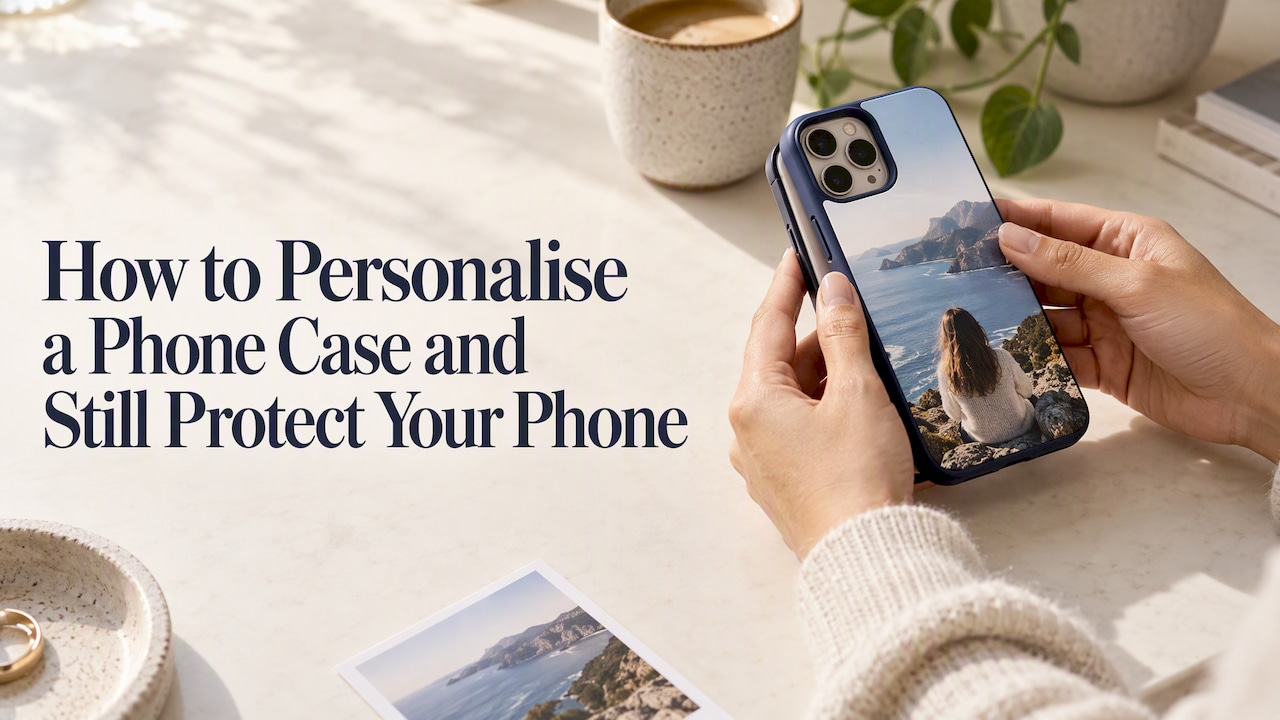
There are four main ways to personalise a phone case in Australia. You can upload your own photo or artwork. You can add your name or initials. You can decorate a case yourself. Or you can choose a limited-run design that nobody else on your street is carrying, then build a look around it with matching accessories. The best pick depends on how much control you want and how much protection your phone needs.
We make the fourth kind, so we’ll be upfront: MONTE cases don’t offer upload-your-own-photo printing. What we do offer is original, fashion-forward designs made in limited runs, with dual-layer drop protection. This guide covers all four routes honestly, so you can choose the one that suits you.
TL;DR
- Personalising a case means choosing between four routes: photo or text printing, DIY decoration, limited-run designs, or building a matching set of accessories.
- Don’t trade protection for looks. Dual-layer polycarbonate cases are the better pick if the phone matters as much as the design, and clear silicone gives style but less impact resistance.
- Custom-made items are usually not covered for change-of-mind returns, so check the seller’s ABN, returns policy and design preview before paying.
- Don’t print celebrity faces, logos or characters on a case you plan to sell or share widely, because Australian law can still bite.
- Matching your case to a ring holder, strap or wallet gives a more polished result than decorating one item in isolation.
Table of Contents
- Four ways to personalise a phone case
- Route 1: photo, initials and text printing
- Route 2: DIY decoration at home
- Route 3: a limited-run design you pick rather than make
- Route 4: personalise the whole set, not just the case
- Don’t give up protection for style
- Perspective: why we think scarcity beats customisation for most people
- What to check before you buy a personalised case
- A legal note on logos, characters and celebrity faces
- Promo: finish the look with MONTE
- Looking after your case, and what to do with the old one
- FAQ
- Sources
Four ways to personalise a phone case
Search for this topic and you’ll find mostly print-on-demand sites where you upload a photo, add text and pay. That is one route, and a good one. It isn’t the only one.
| Route | What you control | Best for | Watch out for |
|---|---|---|---|
| Photo or text printing | Image, font, colours | Gifts, sentimental designs | Photo resolution, case material, no change-of-mind returns |
| DIY decoration | Everything | Craft lovers, tight budgets | Durability, mess, uneven finish |
| Limited-run designs | Which design and colourway you pick | People who want originality without designing | Smaller runs sell out |
| Matched accessory set | The whole look across devices | Anyone who carries more than a phone | Needs a consistent palette |
None of these is wrong. The mistake is choosing a route by looks alone and finding out later that the case cracks on the first tiled-floor drop.
Route 1: photo, initials and text printing
This is the route behind most of the search results. Providers let you upload a photo or artwork, or pick a colour and add a name, nickname or initials. Prices on the pages Google shows for Australia range from about $20 to $30 for a basic printed case, and heavy duty versions with personalisation sit in their own collections.
If you go this way, the quality of your input decides the quality of the case. A sharp photo, a clean font and a pattern at proper resolution matter more than any clever idea. A few practical rules:
- Use the original file from your camera, not a screenshot or a photo sent through a messaging app.
- Keep faces and text away from the camera cut-out and edges, where the print wraps or gets covered.
- Choose one focal point. A busy collage shrinks to mush on a case less than 8 cm wide.
- Save the design preview and your order confirmation. More on why below.
Ideas that work well
Some personalised phone case ideas that tend to look good rather than cheap:
- A single pet or place photo, cropped tightly, on a plain colour.
- Initials in a small, clean font placed low on the case, not centred.
- A map or coordinates of somewhere that matters to you, in one colour.
- Your own illustration or handwriting, scanned flat at high resolution.
- A pattern from your own photos, such as shells or ripples from a favourite beach, repeated rather than enlarged.
If you want more inspiration, Printify’s roundup of design styles covers everything from minimalist to bold looks.
Route 2: DIY decoration at home
Painting, resin, stickers, pressed flowers and engraving are all possible. Home methods give you complete control and cost the least. They also tend to wear fastest. Paint chips at the corners, stickers lift, and resin can yellow or crack on a flexible case.
If you try it, start with a plain, good-quality case and decorate the back only. Keep the sides and camera surround clear so you don’t undermine the structure that absorbs the impact. Treat a DIY case as a statement piece for a few months, not a long-term protector.
Route 3: a limited-run design you pick rather than make
Not everyone wants to design. Plenty of people want a case that looks like nobody else’s and don’t want to wrestle with a template. That is the gap limited-run design fills.
Our cases are fashion-forward designs made in limited runs, available for iPhone, Samsung and Pixel. You choose the design and colourway that reflects your style, and the case arrives finished, with dual-layer protection built to withstand drops. You skip the file-resolution problem entirely, and the originality comes from the design itself being scarce.
You can browse the full range on our phone cases page, where cases are $79. Designs such as Adrift, Florence, Riptide and Vacay show the range from calm to bold.
Route 4: personalise the whole set, not just the case
The quickest way to make a phone case look deliberate is to stop treating it as a lone canvas. Style writers recommend a consistent design language across the whole device suite, such as matching the phone case to a ring holder, iPad case or MacBook cover, in the same colours or motifs.
This is where our range helps. Beyond phone cases, we make:
- MagSafe wallets at $49
- AirPods cases at $39
- AirPods Max cases at $49
- iPad cases at $109
- MacBook cases at $99
- Kindle cases at $69
- A ring holder at $19, a phone strap at $29 and a magnetic grip at $44
Custom bundle options let you mix and match styles and accessories, so the set is yours even though each piece is a finished design.
A simple method for building a set
- Pick the hero. Choose the phone case first, since it’s the piece you see most.
- Pull two colours from it. Take one dominant colour and one accent.
- Match the small items. A ring holder, strap or wallet in the accent colour ties things together cheaply.
- Repeat the motif on the big devices. Carry the same palette onto your tablet or laptop case, and add AirPods if you use them daily.
- Stop at three or four pieces. More than that starts to look like a uniform.
Don’t give up protection for style
The case has one main job. Practitioners advise choosing dual-layer polycarbonate if protection matters as much as the design, and note that clear silicone looks good but absorbs less impact. A thin, fully custom-printed shell can look great and still leave a corner exposed.
Before you buy any personalised case, ask three questions:
- Does it have a raised lip around the screen and camera?
- Is it more than one layer, or a single thin shell?
- Will the print or finish sit on a surface that takes everyday wear?
For most people dropping a phone on concrete or tiles, a dual-layer case is the sensible baseline, and personalisation comes second.
Perspective: why we think scarcity beats customisation for most people
We’ve thought a lot about why most people’s cases are boring. Our view is that the problem isn’t a lack of customisation tools. It’s that a template with your photo in it still looks like a template. Most people don’t want to be a designer, they want a case that looks considered.

So we put the design effort in up front. Each design is made in a limited run, so you aren’t one of thousands wearing the same print. Then we build in the protection people shouldn’t have to think about: two layers that cope with everyday drops. Finally we make the rest of your carry match, from wallets to iPad cases, because a coordinated set is what makes a look read as intentional.
If you want your own face or artwork on a case, a printing service is the right tool and we won’t pretend otherwise. If you want a case that says something about you without the work, that’s what we make.
— User
What to check before you buy a personalised case
Personalised goods carry more risk than off-the-shelf ones, mainly because they can’t be resold and returns get complicated. The ACCC’s online shopping guidance says to check the seller’s reputation, look for an Australian Business Number (ABN) and confirm there is a clear returns process. It also warns that resolving disputes with international or marketplace sellers can be much harder than with a domestic retailer.
A few practical checks:
- Look for an ABN and an Australian returns address. If neither is on the site, think twice.
- Understand what counts as a fault. Change-of-mind returns are typically not covered for personalised items. Consumer guarantees generally apply if the item is faulty, doesn’t match the sample or preview, or fails at its main job, which for a case is protecting the phone. The ACCC’s page sets out your rights when shopping online.
- Screenshot the preview and keep the confirmation email. If the printed case looks different from what you approved, that record is your evidence.
- Check the model. A personalised case ordered for the wrong phone is a change-of-mind problem, not a fault.
A legal note on logos, characters and celebrity faces
If you’re making a case for yourself with a photo of your dog, there’s nothing to worry about. If you’re making cases to sell, or sharing a design widely online, be careful with images you don’t own.
Australia has no standalone right of publicity, but that doesn’t make celebrity images free to use. According to Mallesons’ overview of likeness law, businesses that use a celebrity’s likeness, logos or copyrighted images without permission risk action under the Australian Consumer Law for misleading or deceptive conduct, the tort of passing off, or trade mark infringement. Protection comes from a mix of the Trade Marks Act 1995, the Copyright Act 1968 and common law. If you plan to sell, speak to an IP lawyer before you print.
Promo: finish the look with MONTE
If you’d rather pick a distinctive design than build one, start with our phone cases, $79 each, in limited-run designs for iPhone, Samsung and Pixel with dual-layer drop protection. Add a matching MagSafe wallet at $49 or a ring holder at $19 from the MONTE shop, and you have a coordinated set in a few clicks.
Looking after your case, and what to do with the old one
A personalised case lasts longer if you wipe it with a damp cloth rather than harsh cleaners, and keep it out of a hot car, where heat can warp the shell and fade a print.
When you replace it, don’t bin it with your other rubbish. MobileMuster collects mobile phone accessories as well as handsets, and says it has drop-off points within 10 km for 96% of Australians. It’s a good habit with old chargers and phones too, since lithium-ion batteries in household rubbish cause an average of three fires a day in Australia.
FAQ
Can I put my own photo on a MONTE case?
No. We don’t offer upload-your-own-photo printing. Our cases are original designs made in limited runs, so you personalise by choosing the design and colourway that suits you, then adding matching accessories. If a photo case is what you want, choose a printing service and use a sharp, high-resolution original.
What is the most protective way to have a personalised case?
Choose a dual-layer construction, where a hard outer shell sits over a softer inner layer. Dual-layer polycarbonate cases are generally recommended when protection matters, while clear silicone gives style but less impact resistance. Our cases use dual-layer protection designed to withstand drops.
Can I return a personalised phone case if I change my mind?
Usually not. Personalised goods are typically not covered for change-of-mind returns under Australian consumer guarantees, though you’re protected if the case is faulty, differs from the preview or fails to protect your phone. Check the seller’s returns policy first and keep your design preview and order confirmation. The ACCC explains the rules.
How do I make my phone case match my other accessories?
Pick the phone case first, take its main colour and one accent, then match smaller items such as a ring holder, strap or wallet to that accent. Repeat the palette on bigger devices like an iPad or MacBook case. A consistent colour or motif across the set looks more polished than decorating each item separately.
Sources
- Buying online, ACCC
- Make your own phone case, Printful
- 7 custom phone case ideas that actually look good, PrettyHow
- Phone case design ideas, Printify
- Overview of use of likeness, Mallesons Pulse
- Frequently asked questions, MobileMuster