Phone Case Recycling in Australia: What Works
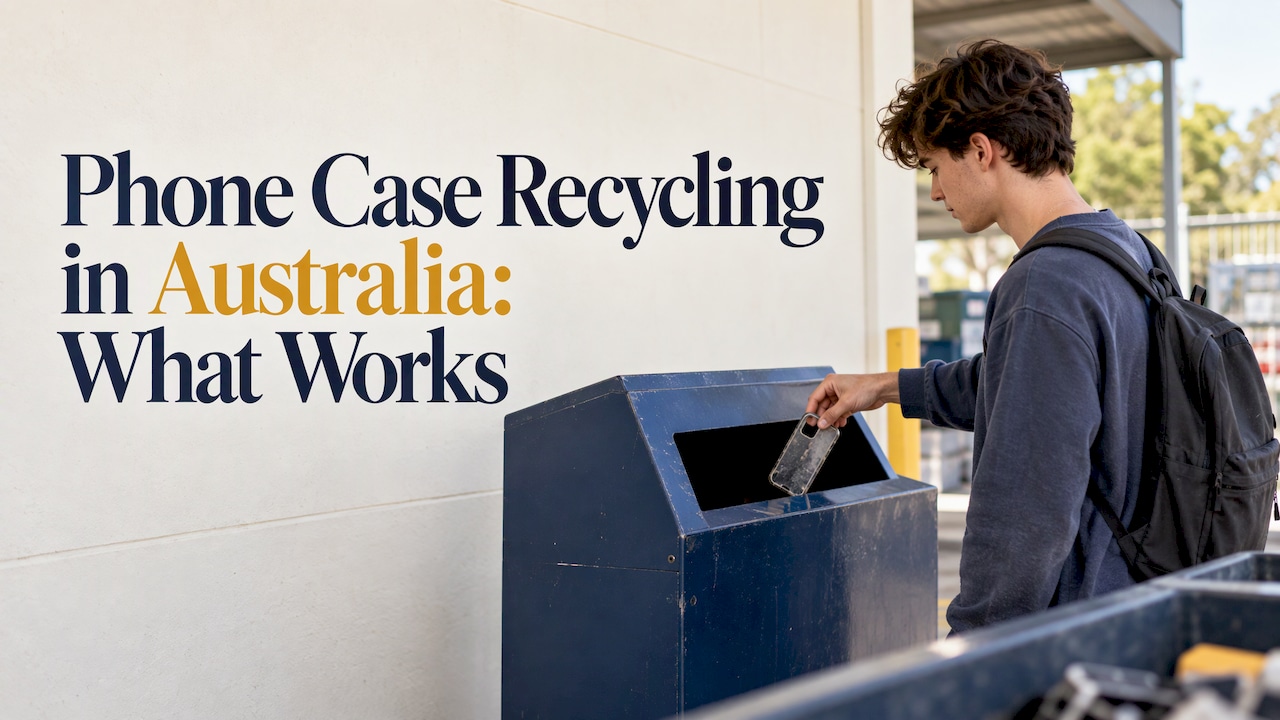
Yes, you can recycle an old phone case in Australia, but not in your home recycling bin. The practical route is MobileMuster, the mobile industry’s free stewardship program, which takes phones and their accessories at thousands of drop-off points and by post. This guide covers what to do with a case you no longer want: how to work out what it is made of, how to prepare it, where to take it and what to do if nothing is nearby.
TL;DR
- Phone cases do not go in the yellow-lidded kerbside bin. Take them to a MobileMuster drop-off point or post them back for free.
- Use Recycle Mate and search “mobile phone case” to find the closest collection point.
- A number inside a triangle on the case tells you the plastic type, not whether your council accepts it.
- Clean the case, remove stick-ons and cards, and keep it separate from loose batteries.
- If no collection point is nearby, the general waste bin is the fallback. Keeping a case in use for longer is the better first move.
Table of Contents
- Can phone cases be recycled in Australia?
- Why a phone case should not go in the kerbside bin
- What is your case made of?
- Plastic codes are not recycling symbols
- How to prepare an old phone case for recycling
- Where to take or send it
- What happens after you drop it off
- If nothing is nearby
- Our perspective
- Choosing your next case
- Ready for a case you will keep?
- FAQ
- Sources
Can phone cases be recycled in Australia?
They can. MobileMuster accepts phone cases, and Recycle Mate’s guidance says its recycling partner can recover more than 95% of the materials in a mobile phone and can process plastic cases and accessories.
MobileMuster is not a private collection scheme. It is the mobile telecommunications industry’s product stewardship program, run by the Australian Mobile Telecommunications Association on behalf of its members. It is voluntary, not-for-profit and funded by the major handset makers and network carriers, so there is no fee for you. The Australian Government’s environment department also lists MobileMuster as a government-accredited organisation that recycles mobile phones and accessories.
The reason cases need a dedicated route is their make-up. Cases in Australia are usually plastic, metal or silicone, and because of that mixed composition they are not accepted in municipal waste programs. They can be sent to companies with the right machinery, including MobileMuster.
Why a phone case should not go in the kerbside bin
The yellow-lidded bin is built for packaging such as bottles and jars. According to Recycle Mate, phone cases cannot be recycled through regular home recycling bins, because other plastic items like phone covers are not accepted in that system.
There is a second reason that applies if your old case is still attached to a phone or sits in a pile with other electronics. Planet Ark’s Recycling Near You says mobile phones, chargers and accessories should never go in household recycling bins, because batteries are hazardous and a fire risk, and these items can only be recycled through specialised programs. Redland City Council gives the same direction: mobile phones and batteries stay out of the recycling bin and go to MobileMuster collection points, a free satchel or a reply-paid label.
So keep the case and any old phone together in one bag for the trip to a drop-off point, rather than sorting the case into the kerbside bin.
What is your case made of?
Most cases are one of three plastics: rigid polycarbonate, flexible TPU or soft silicone. A stiff case that gives a sharp tap sound is likely polycarbonate, a dense, slightly bendy one is likely TPU, and a soft, grippy one is likely silicone. Many two-layer designs combine a hard shell with a flexible inner, which is exactly the mixed construction that makes kerbside recycling unsuitable. For a closer look at how each material behaves, see our guide to phone case materials.

The good news is that you do not need to identify the material perfectly. MobileMuster takes cases as accessories regardless of type, and its facilities handle the separation. Knowing the material matters more when you choose your next case, which we cover in the perspective section below.
Plastic codes are not recycling symbols
Turn your case over and you may find a small triangle with a number from 1 to 7. Many people read that as “recyclable”. It is not.
The South Australian government explains that these numbers are a plastic or resin identification code, not a recycling symbol. The number says what type of plastic the item is, not whether it can be recycled. The ACT Government’s August 2025 factsheet makes the same point: the code helps reprocessors identify and separate plastics, but residents should not rely on it alone because not every plastic type can be recycled locally. Cleanaway adds that whether an item can be recycled depends on its format, available technology and local recycling programs.
The confusion is common. Cleanaway’s 2024 survey found that four in five Australians think the PVC code is a recycling symbol, and one in two would put an item with that symbol in the kerbside bin.
The practical rule for cases: ignore the number when deciding where it goes, and send it through a specialised program. The same habit of looking past a label helps with any product claiming recycled content, which is why guides on checking recycled material claims are worth a read.
How to prepare an old phone case for recycling
Preparation is simple, and it keeps the case easy to process and your drop-off tidy.
- Empty it. Take out cards, notes, SIM tools, pop sockets or stick-on grips. Anything attached with adhesive is better removed.
- Wipe it clean. A damp cloth and a little soap removes grime and sunscreen residue. Let it dry before bagging it.
- Remove detachable extras. Straps, charms and metal rings can come off and be bagged with the case or kept for reuse.
- Keep batteries inside devices. If you are dropping off an old phone too, Brisbane City Council advises keeping the battery inside the phone and wiping personal data before recycling.
- Bag it. Use a paper or reusable bag, or a prepaid satchel if you are posting it.
If the case still looks decent, consider whether someone you know could use it first. A spare case that fits a family member’s phone has more life in it than a recycling bin does.
Where to take or send it
You have three realistic options, and which suits you depends on where you live.
Drop-off points
MobileMuster has more than 3,000 drop-off points across Australia, with one within 10 km for 96% of the population. Many sit in carrier and electronics retail stores. Glen Eira City Council, for example, lists participating Optus, Telstra, Vodafone and Officeworks stores as drop-off points, along with e-waste hubs in its libraries.
Not every store treats a bare case the same way, so use the finder tool below rather than assuming.
Post it back for free
MobileMuster offers three free mailing options:
- Use your own packaging and attach a prepaid returns label (the parcel must not exceed 10 kg).
- Collect a free MobileMuster satchel from select Australia Post locations.
- If you are in a rural or remote area, email mobilemuster@amta.org.au to have a satchel sent to you.
Posting suits anyone without a drop-off point nearby, and lets you bundle several cases, chargers and old phones in one go.
Council recycling hubs
Many councils run e-waste or community recycling hubs that accept phone accessories. Brisbane City Council accepts mobile phones, chargers and accessories at most of its 50-plus community recycling hubs. City of Newcastle points residents to local carrier stores, MobileMuster’s mailing options or the Summerhill Community Recycling Centre. West Tamar Council lists mobile phones and accessories at its Recycling Hub. Check your own council’s website, as hubs and accepted items differ.
Find the closest point with Recycle Mate
Recycle Mate is the easiest check. The Australian Government funded its development in 2020 to provide a database of disposal avenues for e-waste and batteries. Type “mobile phone case” into its search to see the nearest collection point, as Recycle Mate recommends.
What happens after you drop it off
Collected phones and accessories are transported to recycling facilities in Sydney and Melbourne. There they are dismantled by hand and the parts sorted into streams: circuit boards, metal, glass, plastics and batteries. Plastic cases join the plastics stream.

The broader point is that phones are material-rich. Recycling Near You notes they contain precious metals, base metals, plastics and glass, so recycling conserves resources and reduces e-waste. A case dropped off alongside a phone travels the same route, so it is worth doing both on the same trip.
If nothing is nearby
First, try the post-back option, which works from anywhere in the country. If that is not workable for you, Recycle Mate’s advice is that where no MobileMuster location is close, the case goes in the general waste bin. It should not go into the yellow-lidded bin.
The better habit is upstream: buy a case you will not need to replace every year, and a design you still like in twelve months.
Our perspective
We make phone cases, so we think about what happens at the end of a case’s life, but we think about the start of it more. The most useful thing a case can do for the environment is stay on your phone, intact, for as long as you own the device.
That is why we design in limited runs with dual-layer drop protection. A case that survives the drops and still looks good is a case you keep, and a case you keep is one you never have to find a recycling point for. Our designs are meant to be ones people actually want to carry, not placeholders that get swapped after a few months.
When you do upgrade, the same thinking applies. Match the case to your new phone, pick a style you will still like, and send the old one through MobileMuster rather than the bin. If you want to understand what different materials mean for durability and end of life, our guides to sustainable phone case materials and how to choose a phone case are a good place to start.
Josua
Choosing your next case
If you are recycling a case because you have a new phone, a few choices make the next one last longer:
- Fit first. A case cut precisely for your model protects better and does not need replacing when it stretches or loosens.
- Two layers. Dual-layer construction is designed to absorb drops, which is what usually ends a case’s life early.
- A design you will keep. Limited-run prints stay distinctive, so you are less tempted to swap them for something new.
- Matching accessories. A coordinated wallet, AirPods case or strap lets you refresh your look without replacing the case itself.
Our phone cases are $79 and come for iPhone, Samsung and Pixel. If you want a matching set, our MagSafe wallets are $49 and AirPods cases are $39. For help with the magnetic side, read how to choose MagSafe-compatible accessories.
Ready for a case you will keep?
We design fashion-forward, limited-run cases with dual-layer drop protection for iPhone, Samsung and Pixel, plus matching wallets, AirPods cases, iPad cases, Kindle cases and ring holders. You can mix and match styles into a bundle so your whole setup coordinates.

Browse the full range of MONTE phone cases, or start from our shop to build a matching set.
FAQ
Can phone cases be recycled?
Yes. In Australia, MobileMuster accepts phone cases along with phones, chargers and other accessories. You can drop them at a participating collection point or post them back using a free satchel or prepaid label.
How do I recycle an old phone case?
Wipe it clean, remove any cards or stick-on accessories, then search “mobile phone case” on Recycle Mate to find your nearest collection point. If you prefer, collect a free MobileMuster satchel from select Australia Post locations and post it back.
Can I put my phone case in the yellow recycling bin?
No. Kerbside systems are designed mainly for packaging such as bottles and jars, and phone covers are not accepted. Take the case to a MobileMuster drop-off point instead.
Does the number on my case mean it is recyclable?
No. The number from 1 to 7 is a plastic identification code that names the resin type. Whether the item can be recycled depends on local programs and available technology, so use a specialised route such as MobileMuster.
Sources
- MobileMuster, Frequently Asked Questions
- MobileMuster FAQ (PDF)
- MobileMuster, Recycle a mobile
- Recycle Mate, smart phone soft plastic protective cover
- Recycle Mate, phone case
- DCCEEW, How to recycle e-waste
- Waster, How to recycle phone cases
- Recycling Near You, mobile phones
- Redland City Council, A-Z of waste and recycling
- Whichbin SA, what the numbers on plastics mean
- ACT Government, Plastic Identification Codes factsheet
- Cleanaway, Recycling symbols explained
- Cleanaway, 2024 Recycling Behaviour Report
- Brisbane City Council, Community recycling hubs
- Glen Eira City Council, Mobile phones and accessories
- City of Newcastle, Waste and Recycling A-Z
- West Tamar Council, Recycling Hub
- The Meri Jaan, checking recycled material claims